In just five years, Taiwan received 79 applications for AI data center power. Yet the real strain is not on the island's total electricity supply, but on regional grids, substation bottlenecks, and the uneven geography of who bears the costs of the AI boom.
In January 2026, TSMC Chairman and CEO C.C. Wei warned that Taiwan needs sufficient electricity if chipmaking capacity is to keep expanding. His remarks highlighted not only the semiconductor industry's dependence on stable power, but also another fast-rising source of demand: AI data centers.
As AI development accelerates worldwide, data centers have become critical infrastructure for cloud services, model training, and computing deployment. In Taiwan, however, the challenge is not simply how much electricity these facilities use. It is also where they are being built. Because many projects are concentrated in the island's northern metropolitan areas, they are placing new pressure on local grids and substations.
Reporting by The Reporter shows that data centers still account for less than 1% of Taiwan's total electricity use. For now, the more immediate issue is not overall power demand, but whether regional infrastructure can keep up.
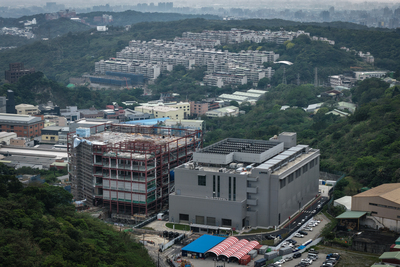
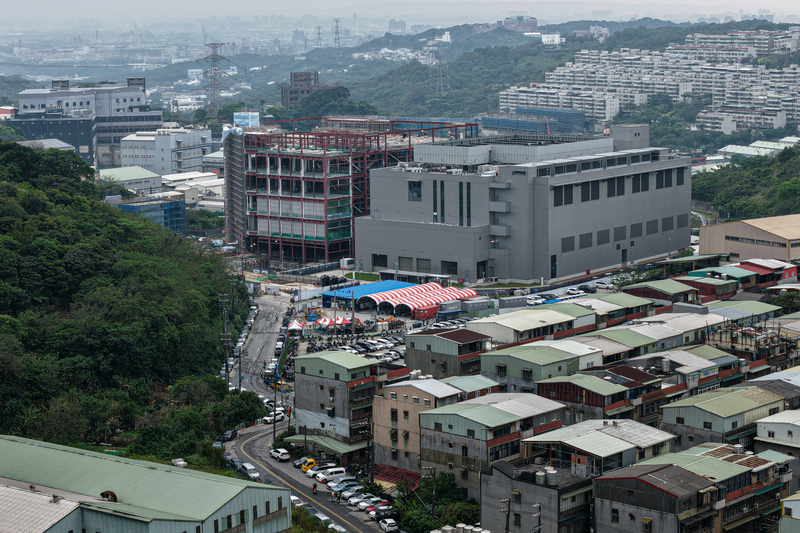
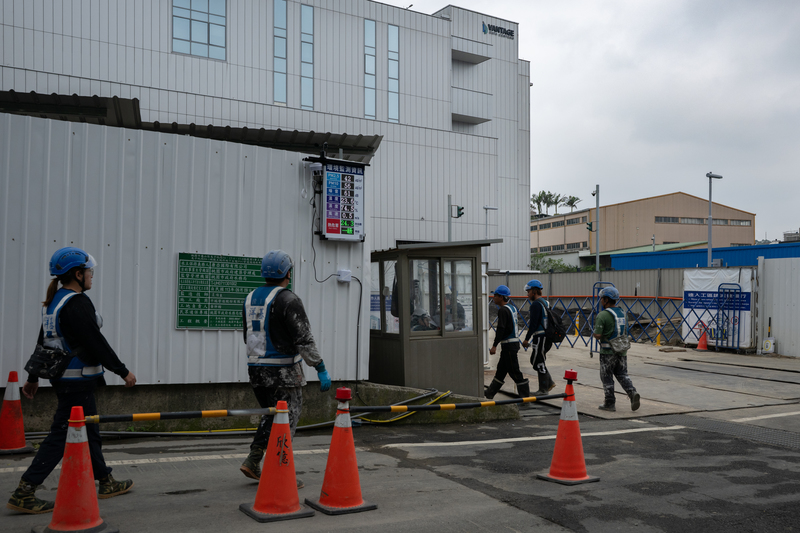
In Guishan, Taoyuan, a narrow turn off a main road leads into Baoshi Street, where dump trucks and construction vehicles move through tight lanes lined with apartment buildings. Behind the Hongbao residential community, on more than four hectares of hillside land, workers in hard hats and reflective vests are rushing to complete a data center campus.
"This project involves two companies, and from what I've heard both are foreign firms," said Chen Wen-Ching, chief of Xinling Village. One completed facility, he said, belongs to the U.S. operator Vantage. A larger one still under construction is backed by Singaporean companies Keppel and DDSP. To support the project's electricity demand, Taipower is also building a 161kV extra-high-voltage transmission line in the area.
For nearby residents, the most visible change is the landscape itself. Chen grew up in an area once shaped by coal mining and brickmaking. The surrounding hills were home to the Sande Coal Mine, and Xinling later became home to several brick kilns.
"At the peak there were three brick kilns here," Chen said. "My father worked in one of them when he was young."
By the 1980s, the kilns had shut down. Some land was redeveloped into apartment blocks; other plots lay vacant for decades. One local resident recalled that vegetables were once grown on the site before construction began and locals learned the project was for AI.
Chen said residents later toured the completed Vantage site, where large cooling systems now keep server rooms at a constant temperature, a stark contrast to the heat of the old kilns.
In the past, coal and clay were burned here to make bricks. Now the same landscape is being repurposed to power chips, servers, and computing capacity.
Most of Taiwan's data centers are located in cities, industrial zones, or science parks. The two international facilities on Baoshi Street are unusual because they sit directly beside a residential neighborhood on a hillside. They have not triggered large-scale protests, but they reflect a broader global pattern: as data centers expand, landscapes and local resources are being reorganized around the digital economy.
"Data center" is a broad term covering facilities where servers, storage systems, and network equipment are housed together. AI data centers are a more specialized subset, equipped with large numbers of GPUs designed for model training and inference. Compared with traditional data centers, they are far more power-intensive: a single server rack can consume more than ten times as much electricity as a conventional one.
Taiwan's Ministry of Economic Affairs defines any data center with electricity demand above 5MW as a large data center. The International Energy Agency describes hyperscale facilities as those requiring 100MW or more, with annual electricity use comparable to that of roughly 350,000 to 400,000 electric vehicles.
A cross-border investigation by The Reporter and the Environmental Reporting Collective found that the expansion of large data centers increasingly raises questions about land use, water demand, and electricity supply. Taiwan has seen far less public resistance than the United States and parts of Europe. For now, debate here is focused mainly on power supply: can the island's electricity system support an AI-driven buildout?
According to Taipower, AI data centers differ sharply from homes, offices, and even conventional factories in their electricity-use profile. Their loads can rival those of semiconductor facilities, but because they occupy relatively little land, they can be placed in dense urban areas, creating unusually high pressure on existing grids.
As of November 2025, Taipower had received 79 AI data center power applications totaling about 4,758MW. Of these, 40 cases totaling roughly 3,033MW were approved, while 39 cases totaling about 1,725MW were rejected. The approved capacity is equivalent to the electricity demand of 15 wafer fabs, or about 1.6 times the installed capacity of Taiwan's Third Nuclear Power Plant.
But those numbers overstate what has actually materialized. Over 70% of the approved capacity has since lapsed because the applicants failed to initiate formal application procedures within six months. International operators often signal interest in Taiwan without committing to direct development, prompting developers and landowners to apply for electricity capacity in hopes of attracting global clients. Many of those projects never advanced, leaving much of the approved capacity stranded on paper.
Furthermore, power applications for data centers have decelerated over the past two years. Because applications surged in northern Taiwan and metropolitan areas, local bottlenecks worsened. Starting in 2024, Taipower suspended new applications for data centers above 5MW north of Taoyuan in order to preserve limited spare capacity.
Among the 40 approved cases, only four sites are currently drawing power, with a combined contracted load of about 303.5MW. Another five are under construction, with roughly 567MW already approved. Together, that amounts to about 870.5MW.
Because the electricity demand of individual sites is treated as commercially sensitive, Taipower does not disclose those figures publicly. The Reporter therefore reconstructed the landscape through public records and interviews.
The first category consists of large self-built facilities operated by global tech companies. Google's data center in Changhua, launched in 2013, remains the largest in Taiwan, with an estimated load of roughly 250MW. Microsoft opened a 40MW facility in Guishan in 2024 and is building another 50MW site in Luzhu. Amazon Web Services launched a Taipei region facility in 2025, though its location and load have not been disclosed.
The second category includes international colocation operators such as Vantage's 25MW facility in Guishan, the 80MW Westwood project backed by Keppel and DDSP, and a 32MW facility under development by Singapore-based Epoch Digital.
The third consists of local operators. Chunghwa Telecom's Banqiao data center has a load of 40MW. Chief Telecom is building two 20MW facilities, one in Neihu and another in the Central Taiwan Science Park. Hon Hai Technology Group (Foxconn) has launched a first-phase 27MW project in Kaohsiung and plans to expand it to as much as 100MW.
Taken together, the projects already operating or under construction amount to roughly 800MW, close to Taipower's tally for energized and under-construction capacity.
Globally, the most closely watched facilities are hyperscale AI data centers built by Google, Microsoft, Amazon, and Meta.
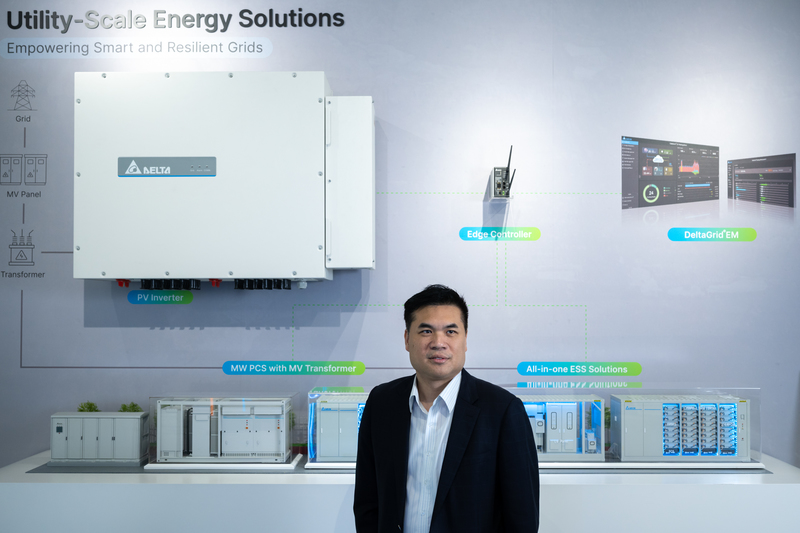
Chen Chih-Min, general manager of Delta Electronics' Microgrid Solutions Business Unit, said projects under discussion overseas are now routinely measured not in tens of megawatts, but in hundreds, or even up to 2GW. That is why international concern about AI data centers tends to focus on the strain they place on power systems and energy supply.
Taiwan, however, has not yet seen that kind of hyperscale buildout at speed. Aside from Google's continuing upgrades in Changhua and Microsoft's ongoing development in Taoyuan, there are few signs of comparable new projects.
Chen Yi-Ling, an analyst at Taiwan's Institute for Information Industry, cautioned against assuming that U.S. growth curves will automatically apply to Taiwan. Much of the world's largest-scale model training remains concentrated in the United States, while many Southeast Asian markets are only beginning to scale up. Taiwan, she said, may not see a more visible surge in demand until three to five years from now.
Taipower estimates that from 2026 to 2030, additional electricity demand from semiconductors and AI-related industries together will exceed 5GW. In a 2024 presentation to Taiwan's National Climate Change Committee, the utility projected that cumulative new AI-related electricity demand, including data centers, would reach about 1.85GW by 2030, while semiconductors alone would add roughly 3.24GW.
Several interviewees questioned whether Taipower's AI forecast may be too high. Only about 567MW of approved capacity is currently tied to AI data centers actually under construction, and a single facility often takes two to three years to build.
Chang Chen-Yan, a policy analyst at the Research Institute for Democracy, Society and Emerging Technology, argued that the more urgent electricity challenge lies elsewhere. Taiwan's current data center market, he said, is still diverse in scale and not dominated by hyperscale facilities. The real pressure comes from the semiconductor sector, which must expand production to support the global boom in AI chips.
"The real energy test Taiwan faces," he said, "comes from the production-side electricity burden its semiconductor industry must bear as a core node in the global AI supply chain."
If Taipower's sales statistics are used as a proxy, the category closest to data centers, “internet portal services and data centers,” saw electricity use rise from about 730 million kWh in 2021 to about 1.5 billion kWh in 2025, nearly doubling in four years. Even so, that still amounted to only about 0.5% of Taiwan's total electricity consumption, which reached 282.8 billion kWh in 2025.
Semiconductor manufacturing tells a very different story. In 2025, the sector consumed 42.38 billion kWh, accounting for nearly 15% of national electricity use. It remains the single largest concentration of power demand in Taiwan.
Even if data centers are not Taiwan's largest electricity consumer, their high load density is already reshaping how grid constraints are felt on the ground.
Liang Pei-Fang, deputy director of ITRI's Green Energy and Environment Research Laboratories, said an ordinary medium-voltage distribution line in Taiwan typically supplies around 5MW to 10MW. For today's large data centers, that is nowhere near enough.
That limitation is now affecting siting decisions. Chief Telecom President Liu Yao-Yuan said that before any data center project can proceed, developers first need to confirm that electricity will be available. When the company applied several years ago to build a 20MW AI data center in Neihu, northern Taipei's local supply was already tight. Delays to the Songhu extra-high-voltage substation project made matters worse.
That was one reason Chief Telecom chose to place its fourth AI data center in central Taiwan instead. The move reflected a broader reality: north of Hsinchu, power supply is becoming increasingly constrained.
Electricity, however, is not the only factor in deciding where to build. Data centers are also shaped by latency, transmission speed, and customer needs. For commercial colocation operators, Liu said, clients still want facilities close to the market.
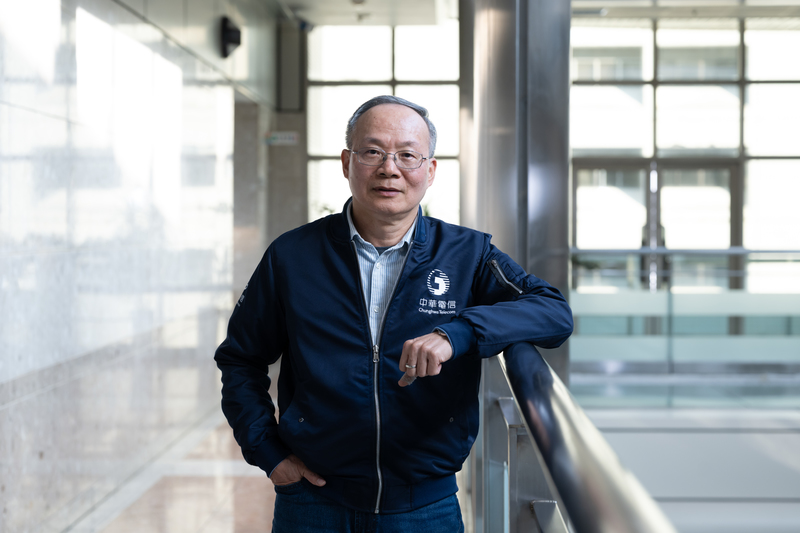
Huang Chih-Hsiung, executive vice president and CTO of Chunghwa Telecom, said future large AI data centers are unlikely to follow the traditional logic of data center construction. Grid and power-supply conditions will need to be built into project planning from the outset, and sites will ideally be located near substations.
Under Chunghwa Telecom's current strategy, existing data centers will be upgraded to support AI workloads while the company also moves toward a more distributed model. Because of regional power constraints, Huang said, data centers will inevitably be spread across multiple locations, and even across borders. The key challenge will be how to connect those dispersed facilities through all-optical networks.
For large tech companies that have pledged to decarbonize, the key question is not only whether electricity is available, but whether renewable supply can grow fast enough to match rising demand.
Google, which operates Taiwan's largest data center, is confronting that challenge directly.
Hsiao Yi-Chun, Google's senior lead for energy and infrastructure in Asia-Pacific, acknowledged that electricity use at data centers is continuing to rise. "Because data centers are using more and more energy, the challenge around green energy is becoming more and more severe," he said.
Google began signing corporate power purchase agreements in 2010 and first reached its annual 100% renewable electricity matching target in 2017. But around 2020, the company found that even when annual totals were fully matched, many hours still depended on fossil-fuel-heavy grid electricity. That led Google to shift toward its 24/7 Carbon-Free Electricity goal: clean power for every hour of the year.
Hsiao said Google prioritizes new local projects over buying output from existing renewable facilities, because that adds new carbon-free electricity to the grid.
But building renewables takes time. Hsiao said Google's global electricity use rose about 27% between 2024 and 2025, while emissions from its data centers fell by 12%, in part because projects contracted earlier only recently began generating power after lengthy development and grid-connection processes.
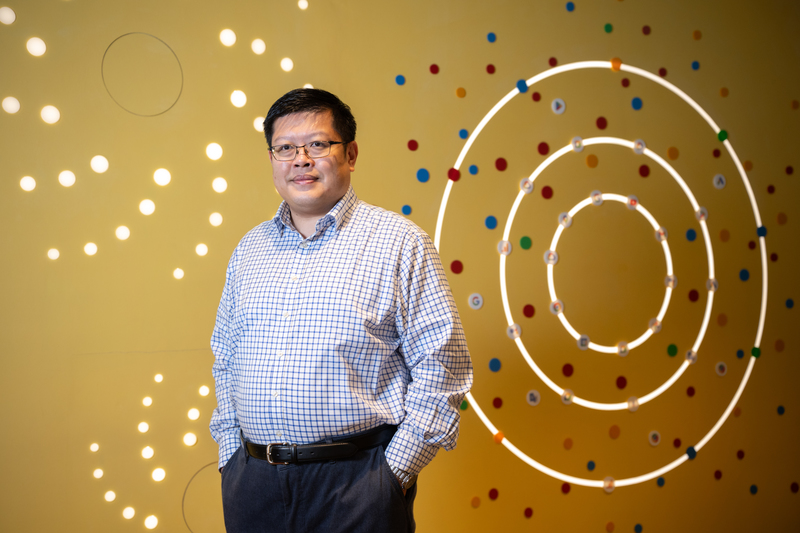
According to Google's 2025 Environmental Report, 66% of the electricity used by its global data centers and offices came from carbon-free sources. In Taiwan, the figure was only 17%. Hsiao said many projects signed in the past two years are still under construction, meaning it may take another two or three years before their impact becomes visible.
That underscores a central problem for companies like Google in Taiwan: the question is not simply how much renewable energy has been contracted, but whether projects can actually be completed and connected to the grid on schedule.
To reach its 24/7 carbon-free electricity target, Google is pursuing a mix of solar, offshore wind, and geothermal in Taiwan. Can it still meet its 2030 goal, given the slower-than-expected rollout of renewables? Hsiao was blunt: the timeline is tight, and more progress is still needed.
In November 2025, Taiwan's Ministry of Economic Affairs formally brought data centers above 5MW under its Energy Usage Plan review regime. Developers building or expanding large data centers must now submit plans detailing how energy will be used and how efficient those facilities will be.
The mechanism itself is not new. It has existed since 2015 and previously applied mainly to power plants, petroleum refining, and large manufacturers consuming more than 25MW. Chen Shih-Hao, director of the Fifth Research Division at the Taiwan Institute of Economic Research, said officials and researchers had been studying data center efficiency for years before the rules were finally amended.
The review covers four broad areas: the type of energy used, the amount required, the location of the project, and its efficiency. Developers must show that a site can secure sufficient power, whether from Taipower or from self-generation.
The revised rules also write Power Usage Effectiveness, or PUE, directly into the regulatory framework. Taiwan's current threshold is below 1.3 for hyperscale data centers and below 1.4 for colocation facilities.
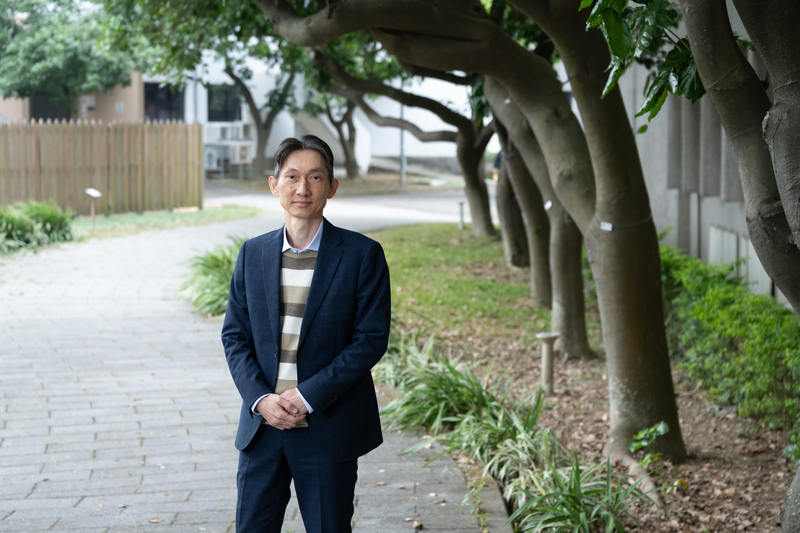
Liang said those benchmarks are already relatively ambitious. Older Taiwanese facilities sometimes posted PUE figures ranging from 1.7 to 2.3, but newer technologies can now achieve 1.1 to 1.2. If a developer still cannot meet the government's threshold, she said, that suggests room for improvement in system design and equipment layout.
Still, PUE has limits. It can show whether a facility is efficient, but not whether its total electricity demand is high, nor whether that electricity comes from renewable sources.
That is why Taipower is also considering other measures, including demand response, on-site generation, locating facilities nearer to power sources or substations, and introducing a special electricity tariff for the data center sector that would more directly reflect grid costs.
Liang said fuel cells could help because they require less land and can be paired with storage systems, though they remain expensive. Building a private gas-fired plant, by contrast, requires much more land and is harder to execute in practice.
Chen of Delta said large data centers are pushing power systems away from dependence on a single source and toward something closer to a microgrid, integrating conventional generation, renewables, storage, and the existing grid to manage the volatile loads of high-density AI servers.
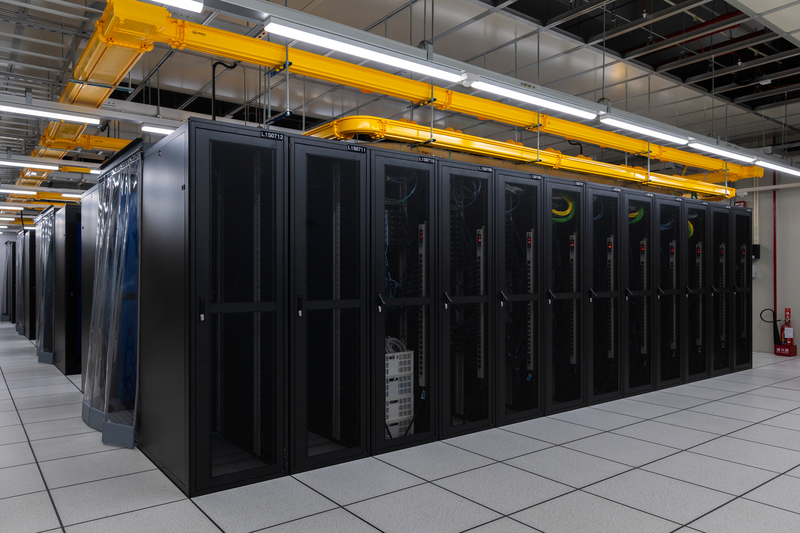
From the new facilities rising in Guishan to the data centers now planned across central and southern Taiwan, AI infrastructure is becoming a more visible part of the island's cities, landscapes, and energy system.
As governments and companies race to secure computing capacity and develop sovereign AI capabilities, the burden on Taiwan's electricity system will not be shaped by data centers alone. It will also run through the semiconductor manufacturing base at the center of the global AI supply chain.
A Greenpeace report released in March argued that the true energy backbone of AI lies in the chipmaking process behind it. If electricity use in semiconductor manufacturing continues to rise faster than Taiwan's energy transition, the climate risks associated with AI expansion will only deepen.
Chang Li-Hsin, climate and energy project director at Greenpeace Taiwan, said electricity-use data from many data centers in Taiwan remains insufficiently transparent. She argued that clearer disclosure is needed, and that key firms across the AI supply chain should aim to run both their operations and supply chains on renewable energy by 2030.
Yeh Chih-Wei, an assistant professor at National Sun Yat-sen University, is currently studying the impacts of AI data centers in Taiwan. In her view, cloud services and AI applications may appear abstract, but the infrastructure behind them is quietly reorganizing very concrete resources: water, electricity, land, and labor.
Yeh warns that the geography of AI infrastructure could deepen existing imbalances within Taiwan. Research, design, and talent remain concentrated in the north, while the south, where electricity infrastructure is relatively more available, may end up absorbing more of the power demand. Yet data centers themselves do not create many direct jobs.
That leaves Taiwan facing a question that goes beyond whether there is enough electricity.
As AI infrastructure expands, the issue is also whether the island is prepared to confront the uneven distribution of costs, resources, and benefits that comes with it.
(To read Chinese version of this article, please click: 台灣資料中心用電壓力大?全球AI熱潮下的區域電網新挑戰)
深度求真 眾聲同行
獨立的精神,是自由思想的條件。獨立的媒體,才能守護公共領域,讓自由的討論和真相浮現。
在艱困的媒體環境,《報導者》堅持以非營利組織的模式投入公共領域的調查與深度報導。我們透過讀者的贊助支持來營運,不仰賴商業廣告置入,在獨立自主的前提下,穿梭在各項重要公共議題中。
今年是《報導者》成立十週年,請支持我們持續追蹤國內外新聞事件的真相,度過下一個十年的挑戰。